There is a trap that almost every new writer, student, and developer falls into when they first discover AI tools.
It goes like this: you open a blank page, feel the familiar discomfort of not knowing where to start, and then type your problem into ChatGPT or Claude. Seconds later, you have a clean, structured, confident-sounding answer.
Problem solved, right?
Not quite.
That shortcut is quietly making you worse at your craft. And the scary part is, you won’t notice it happening until it already has.
Contents
The Real Reason Your First Draft Matters
Most people think the first draft is about producing content.
It’s not. It’s about forcing your brain to work.
When you sit with a blank page and nothing comes, that friction is not a bug in your writing process. It is the process. Your brain is digging through everything it knows, testing connections, rejecting weak ideas, and slowly surfacing something that is actually yours.
Cognitive scientists call this “desirable difficulty.” The harder your brain works to retrieve or construct something, the more deeply it encodes it. When you skip straight to editing AI output, you sidestep this process entirely.
Think about the last time you struggled through a problem on your own vs. the last time you Googled the answer immediately. Which solution do you actually remember?
What Happens to Your Thinking When You Always Use AI First
Here is what nobody talks about.
When you consistently outsource the messy, uncomfortable part of thinking to AI, three things happen gradually:
You lose your own voice. Writing is thinking made visible. If AI does the first round of thinking, the work sounds like AI because it fundamentally is AI thinking, just lightly edited by you.
You stop noticing what you don’t know. The struggle to write something is often when you discover you don’t actually understand it well enough. AI skips this diagnostic. It produces a confident answer regardless of whether you have a genuine grasp of the topic.
Your output becomes generic. AI is trained on the average of everything. Its defaults are statistically safe, meaning they are the same things everyone else is saying. Your competitive edge as a writer or creator is your specific experience and perspective, and AI cannot access that.
The Coding Example That Makes This Concrete
If you are a developer, you have probably seen this play out firsthand.
You ask an AI to write a function. It works. You move on. Three days later something breaks and you have no idea why, because you never understood what the code was doing in the first place. Debugging takes twice as long as it would have if you had written the thing yourself.
Compare that to a developer who built a rough, messy first version, hit errors, fixed them, and understood the logic. When something breaks for them, they know exactly where to look.
The AI-assisted code looked better on day one. The self-written code produced a better developer by day three.
The same principle applies to every creative or knowledge discipline.
When AI Actually Helps (and When It Doesn’t)
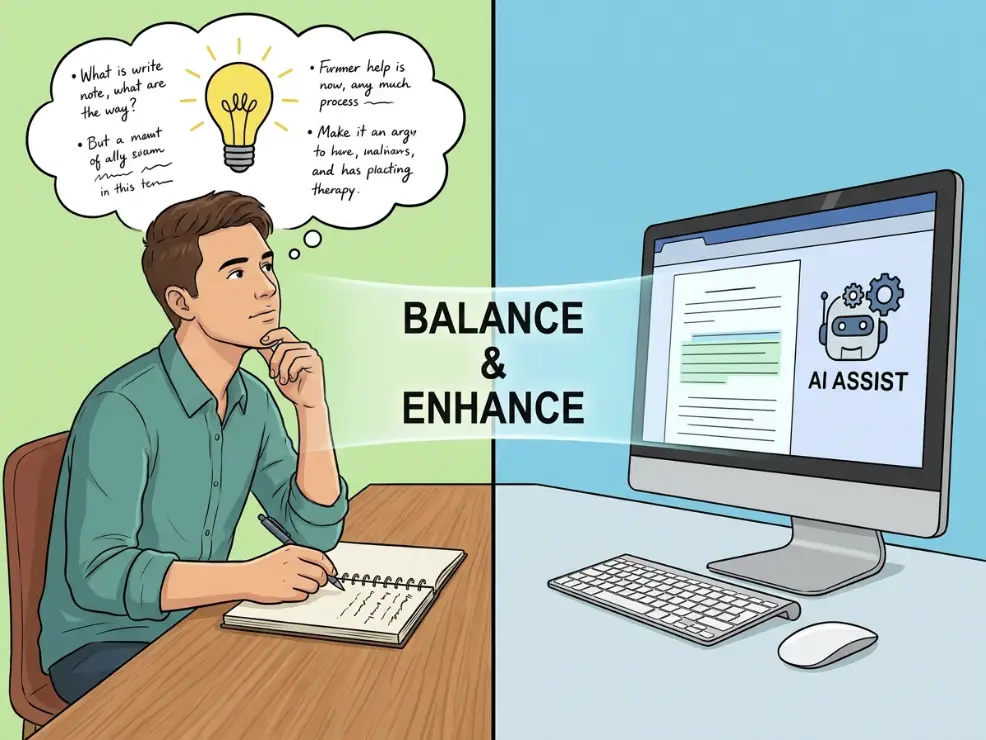
To be clear, this is not an argument against using AI. It is an argument about where in your process AI belongs.
AI is genuinely powerful for:
- Refining a draft you already wrote
- Catching logical gaps in an argument you developed yourself
- Suggesting structural improvements to content you understand deeply
- Speeding up research on topics you already have a baseline in
- Editing for clarity and conciseness after the thinking is done
AI is counterproductive when used for:
- Replacing the initial thinking and outlining phase
- Writing on topics you have no firsthand experience with and presenting it as your own perspective
- Generating content so fast that you never actually engage with the subject matter
The difference is simple. AI working with your ideas is powerful. AI replacing your ideas is a slow drain on your actual capabilities.
A Practical Process That Actually Works
Here is a workflow that takes more time upfront but produces far better results, and builds real skill over time.
Step 1: Brain dump for 10 minutes without any tools open.
No browser, no AI, no notes. Just you and a blank document. Write everything you already know or think about the topic. It doesn’t need to make sense. This is for your eyes only.
Step 2: Identify the gaps.
Look at what you wrote. Where did you get stuck or vague? Those gaps are what you actually need to research or think through. Now use AI or search to fill those specific gaps, not to rewrite your whole draft.
Step 3: Write a rough first draft from your brain dump.
Ugly is fine. Incomplete is fine. What matters is that the structure and ideas are yours. This draft might be embarrassing. That is a sign you are doing it right.
Step 4: Bring in AI as an editor.
Paste your draft and ask AI to improve clarity, fix awkward sentences, or suggest where your argument is weak. This is AI at its best. It is reacting to your thinking rather than replacing it.
Step 5: Rewrite the final version yourself.
Don’t just accept the AI’s edits. Read them, understand the suggestions, and rewrite in your own words. This keeps your voice in the work.
The Long Game
There is a reason experienced writers, developers, and thinkers tend to use AI less aggressively than beginners.
They have spent years building a mental model of what good looks like in their field. They use AI to move faster, not to think for them, because they know the difference between the two.
Beginners who skip straight to AI never build that mental model. They can produce content quickly but cannot evaluate whether it is any good without asking the AI again.
The people who will be most valuable in an AI-saturated world are not the ones who are best at prompting. They are the ones who developed genuine depth of knowledge and skill before AI became the default shortcut. AI amplifies what you already have. If you have nothing, it has nothing to amplify.
One Rule to Keep Everything in Check
Think first. Write rough. Use AI to refine.
That sequence keeps the learning, the voice, and the real value on your side of the equation. Flip it, and you are just a slightly smarter copy-paste machine.
The blank page is uncomfortable on purpose. Sit with it a little longer.
Found this useful? You might also enjoy What Does 256-bit Encryption Mean, and How Secure is it? .
FAQ
Does Google penalize AI-written content?
Google does not penalize AI-assisted content by default. It penalizes content that is low-quality, unhelpful, or clearly produced at scale with no human value added. If your content is original, helpful, and written with genuine insight, AI assistance is fine.
Should I use AI to write my first draft?
For most writers, no. Writing your own first draft builds understanding, voice, and real skill. Use AI after you have a rough version to refine and improve, not to replace the thinking stage.
What is the best way to use AI for blog writing?
Write your rough draft first, then use AI to tighten sentences, find logical gaps, and improve clarity. This keeps your voice and ideas in the work while letting AI do what it is actually good at.
